Industrial Transformer Calculations
Transformers are the backbone of industrial power systems, facilitating the safe and efficient transfer of electrical energy across different voltage levels. Understanding industrial transformer calculations is crucial for engineers, technicians, and anyone involved in designing or maintaining electrical systems. This article provides an easy-to-understand tutorial on essential transformer calculations, ensuring that readers grasp the fundamental concepts and can apply them in real-world scenarios.
Understanding the Basics of Transformers
Before delving into industrial transformer calculations, it’s important to comprehend how transformers operate. A transformer is an electrical device that transfers energy between two or more circuits through electromagnetic induction. It consists of primary and secondary windings wrapped around a magnetic core. The primary winding receives the input voltage, and the secondary winding delivers the output voltage.
Key Principles:
- Voltage Transformation: The transformer changes voltage levels based on the ratio of turns in the primary and secondary windings.
- Current Transformation: As voltage changes, current adjusts inversely to maintain the same power level (ignoring losses).
- Power Conservation: Ideally, the power input to the primary winding equals the power output from the secondary winding (P_primary = P_secondary).
Essential Industrial Transformer Calculations
Understanding and performing the following calculations are vital for anyone working with industrial transformers.
1. Turns Ratio Calculation
Definition: The turns ratio is the ratio of the number of turns in the primary winding to the number of turns in the secondary winding. It determines how the transformer will step up or step down voltages.

2. Voltage Calculation
Definition: Determines the secondary voltage based on the primary voltage and the turns ratio.

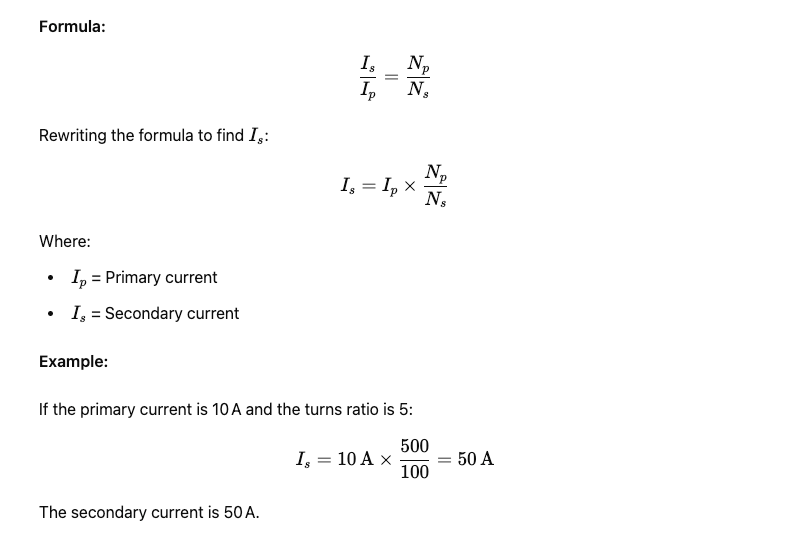
3. Current Calculation
Definition: Calculates the secondary current based on the primary current and the turns ratio.
4. Power Calculation
Definition: Ensures that power remains consistent (ignoring losses) between the primary and secondary windings.

5. Efficiency Calculation
Definition: Measures how effectively a transformer converts input power to output power, accounting for losses due to resistance, hysteresis, and eddy currents.

6. Impedance Calculation
Definition: Impedance affects how voltage and current change under load conditions, important for determining voltage regulation.

7. kVA Rating Calculation
Definition: Determines the apparent power rating, crucial for selecting a transformer that can handle the required load.

Selecting the Right Industrial Transformer
Choosing the appropriate transformer involves more than just calculations. Consider the following:
- Load Requirements: Assess the maximum load the transformer needs to handle.
- Voltage Levels: Ensure the transformer can step up or step down to the required voltage.
- Environmental Conditions: Account for temperature, humidity, and other environmental factors.
- Regulatory Standards: Comply with industry regulations and safety standards.
Importance of Accurate Industrial Transformer Calculations
Accurate industrial transformer calculations are essential for:
- Safety: Preventing overloads and potential hazards.
- Efficiency: Reducing energy losses and operating costs.
- Longevity: Extending the life of the transformer by avoiding excessive stress.
- Compliance: Meeting legal and industry-specific standards.
Conclusion
Understanding and applying fundamental transformer calculations is indispensable in the industrial sector. By mastering these calculations, professionals can ensure the safe, efficient, and reliable operation of electrical systems. Whether designing a new system or maintaining an existing one, these calculations form the foundation of effective transformer utilization.
If you have an industrial transformer that you are ready to retire, contact us! ATS is the leading industrial transformer buyer in the nation!